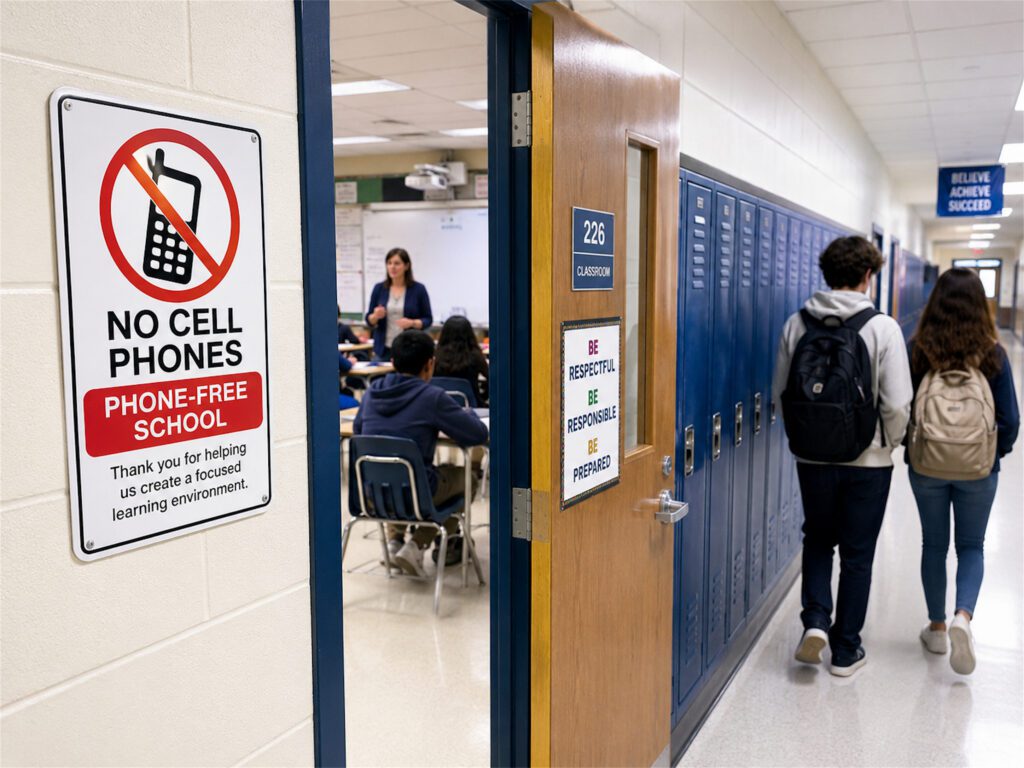
On October 26, Governor Shapiro signed Senate Bill 1014 (SB 1014) into law, effectively banning student use of cell phones in schools effective for the 2027-28 school year. Pennsylvania is one of more than two dozen states to enact a cell phone-free school day. Here’s what administrators and districts need to know as they prepare to comply with this new law.
What prompted this legislative change?
According to the Governor’s announcement, a 2025 survey provided insights that helped shape the SB 1014 includes:
- 24 percent of students reported spending four or more hours per school day on social media
- 36.3 percent reported four or more hours of total non-school screen time
This echoes empirical data shared by global nonprofit The TAG Movement, launched after the publishing of The Anxious Generation, a book by NYU social psychologist Jonathan Haidt. In short, Haidt’s research revealed how a rapidly developing tech-based childhood has dramatically impacted how kids think, feel, grow, and learn and caused a myriad of undesirable impacts like anxiety, addiction, sleep deprivation and more. One of his recommendations for removing distractions and the harm of addictive technology is phone-free schools.
Mr. Haidt was quoted in the Governor’s announcement, saying, “Pennsylvania lawmakers have given students opportunities for distraction free learning, and so much more. When students put their phones away for the day, they learn more from their teachers, develop longer attention spans, and have more fun with each other.”
What are the requirements?
Schools will have flexibility in how they implement their policies, but requirements of adopted policies include:
- Establish how a student’s phone use will be restricted during the school day while on school property
- Parent notification of emergency communication procedures and how to reach their student during the school day
- Accommodation for necessary exceptions (see below)
- Opportunities for public input
- Published online within five days once finalized, as well as submitted to the Pennsylvania Department of Education
- Finalized in advance of the 2027-28 school year
It’s also important to note that the bill does not require the school to take physical possession of a device.
Do all schools need to comply?
Other than homeschooling, SB 1014 requires the following schools to comply:
- traditional public schools
- school district intermediate units
- area career and technical schools
- charter schools
- regional charter schools
- private schools
- nonpublic schools, and
- cyber charter schools
Are there exceptions to SB 1014?
Yes, the bill makes exceptions for the following:
- documented medical needs
- special education or disability accommodations (IEP and Section 504 plans)
- English language learning devices, and
- other pre-approved, limited instructional purposes
The Governor noted this is not a one-size-fits-all ban and schools can determine how to best accommodate their students.
Guidance for adoption success
It’s important to remember the various audiences and stakeholders impacted by your school’s new policy: students, parents, teachers and staff. As your policy will require school board approval and may result in public input, consider the following when creating your policy:
- Equity and accessibility – Ensure the policy doesn’t inadvertently interfere with disability accommodations, medical monitoring or translation needs. Make exceptions workable in practice, not just on paper.
- Instructional technology – Confirm that school-issued devices and necessary learning platforms remain available and accessible. Teachers need clarity on the difference between personal phones and approved school technology.
- Budget and staffing – If included in your school’s policy, account for storage equipment, locked pouches, staff training, administrative time and new communication procedures.
- Student culture and adjustment – Prepare students for the change, explain expectations and consider identifying alternatives for downtime and social interaction. Consider differing impacts on age levels, i.e. elementary vs. secondary schools and initial resistance.
- Emergencies and routine communication – Educate parents on how they will continue to have access to their children and any new methods for communicating day-to-day info, as well as safety-related issues will be in place.
- Evaluation and accountability – Establish a baseline and review student engagement, student/parent/staff feedback and any classroom disruptions or disciplinary incidents after implementation. This can help schools determine what is working and where procedures need adjustment.
Support for creating your school’s cell phone ban policy
As schools of all types seek to create and enact their cell phone ban policies, it’s important to meet the objective: banning cell phone use, while also accommodating exceptions and meeting the deadline of the 2027-28 school year.
In addition to incorporation and governance work, our Education Law attorneys help with day-to-day legal issues like investigations and compliance with local, state and federal law. Please connect with us for support in creating a policy that is consistent, enforceable, and successful.